VAT Rules When Importing from Germany (Complete Guide)
Understanding VAT (Value Added Tax) is essential when importing goods from Germany. Whether you’re a beginner or running an import business, VAT directly affects your total cost, pricing, and profitability.
This guide breaks down VAT rules in a simple, practical way.
What is VAT in Importing?
VAT (Value Added Tax) is a consumption tax applied to goods and services. When importing from Germany, VAT may be applied in two stages:
- In Germany (Export Stage)
- In Your Country (Import Stage)
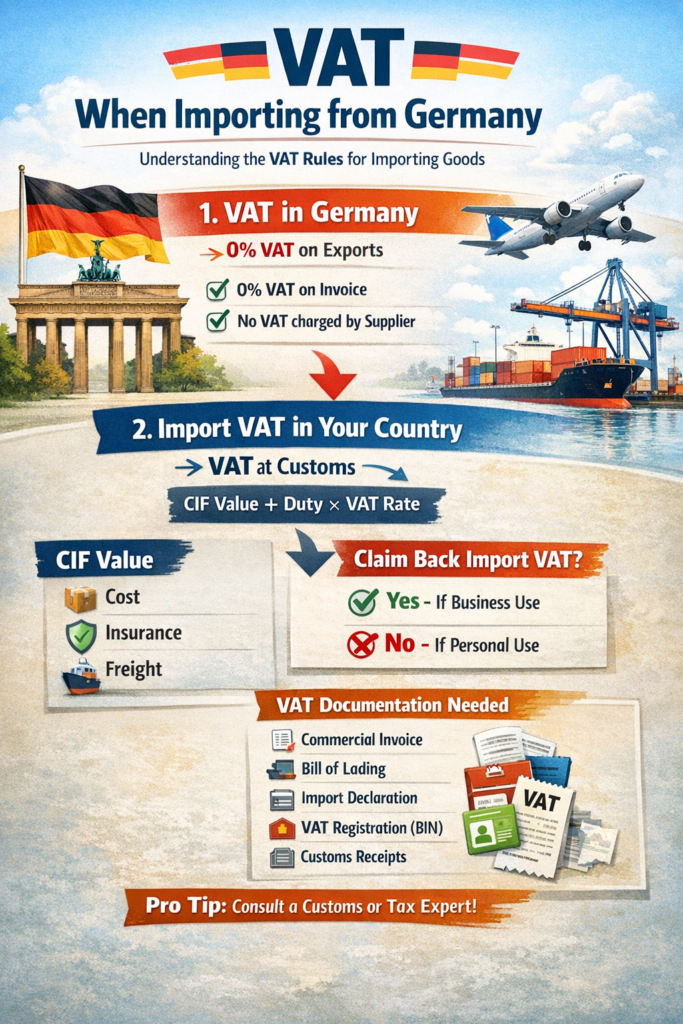
1. VAT in Germany (Exports Are Usually 0%)
Good news 👇
When goods are exported from Germany to a non-EU country (like Bangladesh), they are generally zero-rated for VAT.
What this means:
- German supplier does NOT charge VAT
- Invoice will show 0% VAT
- You only pay the product price (excluding German VAT)
👉 This is called a VAT-exempt export.
2. Import VAT in Your Country
Even though Germany doesn’t charge VAT, you must pay Import VAT in your country.
In Bangladesh:
- Import VAT is charged at the time of customs clearance
- Calculated based on CIF value (Cost + Insurance + Freight)
Formula:
Import VAT = (CIF Value + Customs Duty + Other Taxes) × VAT Rate
👉 VAT rate depends on your country’s tax policy.
3. CIF Value Explained
CIF stands for:
- Cost of goods
- Insurance cost
- Freight (shipping cost)
This total value is used to calculate VAT and duties.
4. Do You Need VAT Registration?
Yes, in most cases.
You need VAT registration if:
- You run a business
- You import goods regularly
- You want to claim VAT benefits
👉 In Bangladesh, you’ll need a BIN (Business Identification Number).
5. Can You Claim Back Import VAT?
This depends on your business type.
You CAN claim VAT if:
- You are VAT-registered
- Goods are used for business purposes
- You maintain proper records
👉 This is called Input VAT Credit.
You CANNOT claim VAT if:
- You are an individual importer
- Goods are for personal use
6. VAT Documentation Required
To handle VAT properly, you’ll need:
- Commercial Invoice (0% VAT from Germany)
- Bill of Lading / Airway Bill
- Import Declaration
- VAT Registration (BIN)
- Customs Duty Payment Receipt
👉 These documents are required for VAT calculation and compliance.
7. Reverse Charge Mechanism (Important Concept)
In some cases, VAT is handled using the Reverse Charge Mechanism.
Meaning:
- Supplier (Germany) does NOT charge VAT
- Buyer (you) is responsible for VAT in your country
👉 This is common in international trade.
8. Common Mistakes to Avoid ❌
Many beginners lose money due to VAT mistakes:
- ❌ Assuming no VAT applies at all
- ❌ Not including shipping in VAT calculation
- ❌ Importing without VAT registration
- ❌ Poor documentation (can block VAT claims)
Final Thoughts
VAT is not just a tax—it’s a key part of your import cost structure.
When importing from Germany:
- You usually pay 0% VAT in Germany
- But must pay Import VAT locally
- Proper registration and documentation can help you recover VAT and increase profit
Pro Tip 💡
If you’re just starting out, work with:
- A customs clearing agent
- Or a tax consultant
They can help you optimize VAT and avoid costly mistakes.