Customs Clearance Process for Exports from Germany (Step-by-Step Guide)
Exporting goods from Germany involves a well-structured customs clearance process. Germany is known for its strict compliance and efficient systems, so understanding each step will help you avoid delays, penalties, and unnecessary costs.
This guide explains the full customs clearance process for exports from Germany in a simple and practical way.
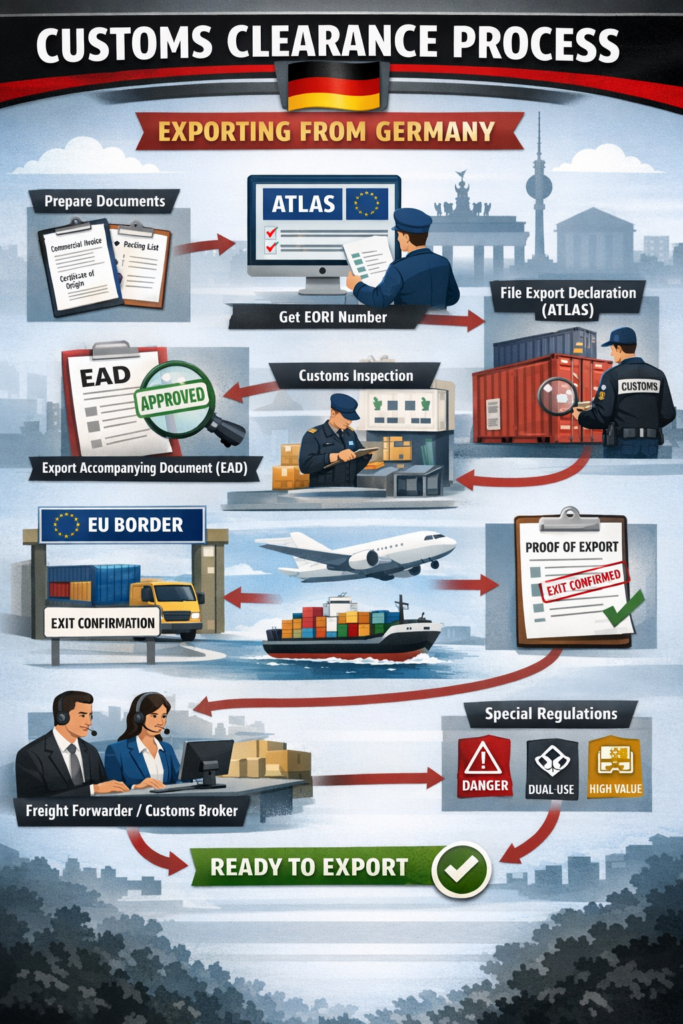
1. Prepare Export Documents
Before anything else, the exporter must prepare all required documents.
Key documents include:
- Commercial Invoice
- Packing List
- Sales Contract
- Export License (if required)
- Certificate of Origin
👉 Missing or incorrect documents can delay the entire process.
2. Obtain an EORI Number
An EORI (Economic Operators Registration and Identification) number is mandatory for exporting from Germany.
Why it’s needed:
- Identifies businesses in customs systems
- Required for all export declarations within the EU
👉 Without an EORI number, you cannot legally export goods.
3. Export Declaration (ATLAS System)
Germany uses the ATLAS electronic customs system for export declarations.
Process:
- Exporter or customs agent submits declaration online
- Includes product details, value, HS code, and destination country
👉 This is a crucial step for customs approval.
4. Customs Inspection & Risk Assessment
After submission, German customs may:
- Approve shipment directly
- Request additional documents
- Select goods for physical inspection
Inspection may include:
- Checking product compliance
- Verifying declared value
- Ensuring no restricted goods are included
👉 Not all shipments are inspected, but be prepared.
5. Export Accompanying Document (EAD)
Once the export declaration is approved, customs issues an Export Accompanying Document (EAD).
Purpose:
- Proof that goods are cleared for export
- Must travel with the shipment
👉 This document is essential for the next stage.
6. Exit Confirmation (Proof of Export)
When goods leave the European Union, customs generates an Exit Confirmation.
Why it matters:
- Proof that goods have been exported
- Required for VAT exemption (0% VAT)
👉 Without this, tax authorities may not accept VAT-free export.
7. Transportation & Shipping
After clearance:
- Goods are handed over to the carrier (sea, air, or land)
- Transport documents are issued:
- Bill of Lading (B/L)
- Airway Bill (AWB)
👉 These are needed by the importer to receive goods.
8. Customs Broker / Freight Forwarder Role
Many exporters use:
- Customs brokers
- Freight forwarders
They help with:
- Document preparation
- Filing export declarations
- Handling customs communication
👉 This reduces errors and speeds up the process.
9. Special Cases (Important)
Some goods require extra steps:
Examples:
- Dual-use goods → Need special export license
- Dangerous goods → Require safety documentation
- High-value shipments → May face stricter checks
👉 Always check regulations before exporting.
10. Common Mistakes to Avoid ❌
- ❌ Incorrect HS code
- ❌ Missing EORI number
- ❌ Wrong product valuation
- ❌ Incomplete export declaration
- ❌ Ignoring compliance requirements
👉 These can cause delays or fines.
Final Thoughts
The customs clearance process for exports from Germany is highly organized but requires accuracy and proper documentation.
Quick Summary:
- Prepare documents
- Get EORI number
- Submit export declaration (ATLAS)
- Customs review & approval
- Receive EAD
- Goods exit EU & get confirmation
- Ship to destination
Pro Tip 💡
If you’re new to exporting from Germany, always work with a professional customs broker or freight forwarder. It will save you time, reduce risk, and ensure compliance with German and EU regulations.