
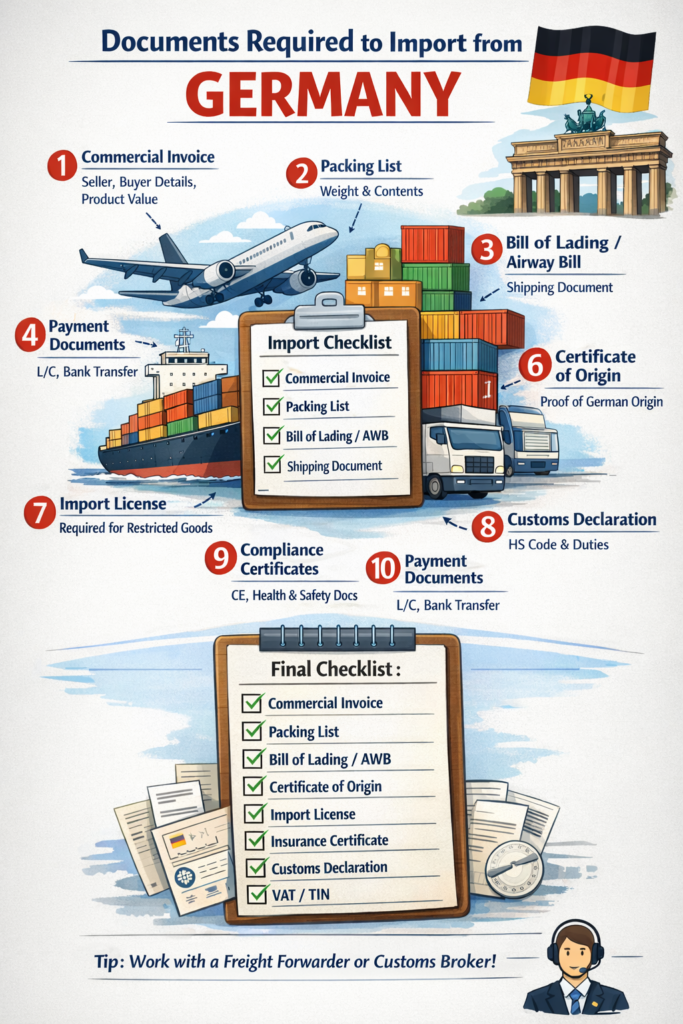
Documents Required to Import from Germany (Complete Guide)
Importing products from Germany can be a profitable opportunity, especially because Germany is known for high-quality manufacturing and strict standards. However, to ensure smooth customs clearance and avoid delays, you must have the correct documentation in place.
In this guide, you’ll learn all the essential documents required to import goods from Germany step by step.
1. Commercial Invoice
The Commercial Invoice is the most important document in any import process.
What it includes:
- Seller (exporter) and buyer (importer) details
- Product description
- Quantity and price
- Total value of goods
- Payment terms (e.g., FOB, CIF)
👉 Customs authorities use this document to calculate duties and taxes.
2. Packing List
The Packing List provides detailed information about how the goods are packed.
It includes:
- Number of packages
- Weight (gross & net)
- Dimensions
- Packaging type (carton, pallet, etc.)
👉 This helps customs and logistics companies verify the shipment.
3. Bill of Lading (B/L) or Airway Bill (AWB)
This is a transport document issued by the shipping company.
Types:
- Bill of Lading (B/L) → For sea shipments
- Airway Bill (AWB) → For air shipments
Purpose:
- Proof of shipment
- Ownership of goods
- Required to release cargo
4. Import License (if required)
Depending on your country and product type, you may need an Import License.
Required for:
- Restricted goods
- Regulated industries (electronics, chemicals, medical equipment)
👉 Check your country’s import regulations before placing an order.
5. Certificate of Origin (COO)
This document confirms that the goods were manufactured in Germany.
Why it matters:
- Helps determine import duties
- Required for trade agreements or reduced tariffs
👉 Usually issued by a German Chamber of Commerce.
6. Insurance Certificate
If your shipment is insured, you will receive an Insurance Certificate.
It covers:
- Damage
- Loss during transit
👉 Especially important for high-value shipments.
7. Letter of Credit (L/C) or Payment Documents
If you are using bank payment methods, you may need:
- Letter of Credit (L/C)
- Bank transfer documents
- Payment confirmation
👉 These ensure secure international transactions.
8. Import Declaration / Customs Entry
You must submit an Import Declaration to your country’s customs authority.
Includes:
- HS Code (Harmonized System Code)
- Product value
- Country of origin
- Import duties calculation
👉 Usually handled by a customs clearing agent.
9. Product Compliance Certificates
Germany has strict quality standards. Some products require compliance documents:
Examples:
- CE Marking (for electronics and machinery)
- Health certificates (for food or cosmetics)
- Safety certificates
👉 Without these, your shipment may be rejected.
10. Tax Identification & VAT Registration
As an importer, you may need:
- Tax Identification Number (TIN)
- VAT Registration
👉 Required for customs clearance and legal importing.
Final Checklist ✅
Before importing from Germany, make sure you have:
- Commercial Invoice
- Packing List
- Bill of Lading / Airway Bill
- Import License (if needed)
- Certificate of Origin
- Insurance Certificate
- Payment Documents
- Import Declaration
- Compliance Certificates
- TIN / VAT Registration
Final Thoughts
Importing from Germany is a great business opportunity, but documentation is critical. Even a small mistake can delay your shipment or increase costs.
If you’re just starting, it’s a good idea to work with a freight forwarder or customs broker who can handle documentation and clearance for you.