If you are importing from Europe, learning how to check german supplier legitimacy is one of the most important risk-control steps before sending payment.
A professional website alone does not prove a supplier is real. Many scammers copy factory photos, fake certifications, and even use similar company names.
The good news is that verifying a german supplier is easier when you follow a structured due diligence process.
In this guide, you’ll learn the exact steps professionals use to confirm whether a German supplier is legally registered, financially credible, export-ready, and safe to pay.
Table of Contents
- Why german supplier legitimacy matters
- Step-by-step supplier verification process
- Official tools to verify a German supplier
- Red flags and common scams
- Expert tips and common mistakes
- Pros and cons of German supplier checks
- FAQs
- Final checklist
Why German Supplier Legitimacy Matters
Before placing your first order, german supplier legitimacy checks help you avoid:
- fake companies
- impersonation scams
- invalid VAT invoices
- non-compliant goods
- fake CE certificates
- wrong bank account payments
- shipment fraud
- customs issues
A single wrong payment can cost thousands.
Statistics placeholder:
Companies that follow supplier due diligence reduce fraud risk by [XX%].
Step-by-Step: How to Verify German Supplier Legitimacy
This is the safest workflow for checking any german supplier.
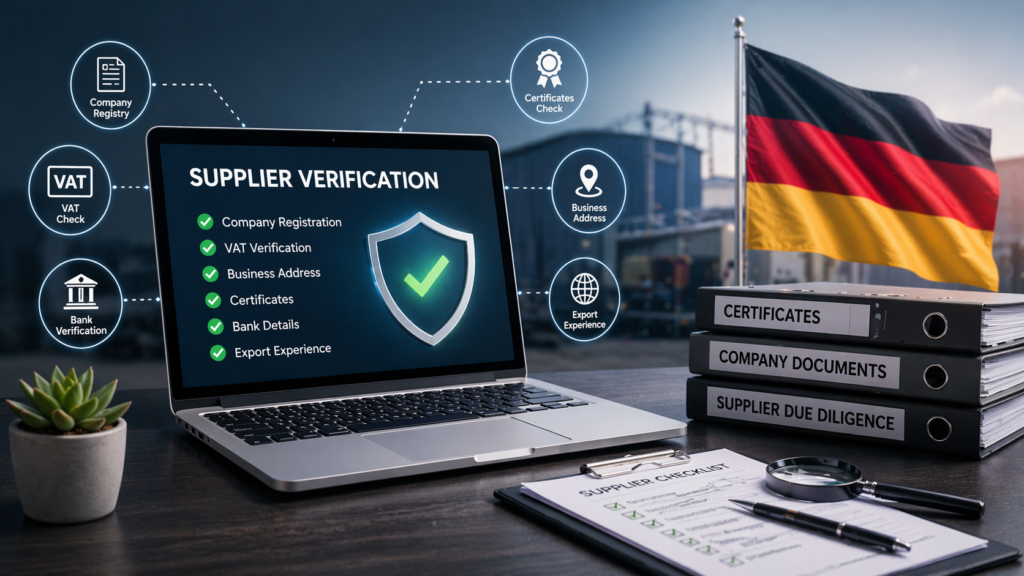
Step 1: Check the Official Company Registration
The first thing to verify is whether the supplier is legally registered in Germany.
Use:
- Handelsregister
- Unternehmensregister
- official chamber directories
- local industry associations
Germany’s Handelsregister is the official commercial register used to confirm legal existence and registration details. Recent due-diligence guides highlight it as the primary source for company verification.
Verify these details
- exact legal company name
- registration number
- registered city
- legal form (GmbH, AG, UG)
- managing director
- business scope
- incorporation date
Pro tip
Ask the supplier for their full registered German legal name, not just the brand name.
Many scams use trading names that look similar to real companies.
Step 2: Verify VAT Number
One of the fastest ways to check german supplier legitimacy is VAT validation.
Use the official EU VIES VAT system. It checks if the supplier is registered for cross-border EU trade.
What to check
- VAT number starts with DE
- legal name matches
- registered address matches
- status = valid
- timestamp screenshot saved
If the VAT number is invalid, it may mean:
- fake supplier
- wrong legal entity
- inactive cross-border VAT
- unfinished registration
Best practice
Always save proof of the VAT check for compliance and tax audits.
Step 3: Review Website Legal Pages
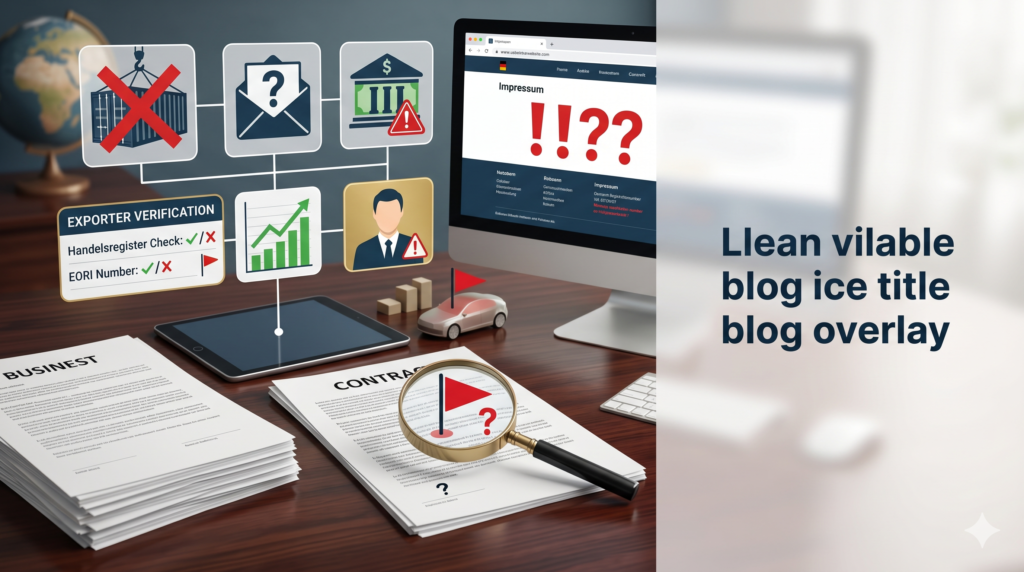
A real German business website must usually include an Impressum (legal disclosure page).
Check:
- legal company name
- VAT ID
- managing director
- registered office
- email domain
- phone number
- court registration info
Red flag
If the website has:
- no Impressum
- Gmail email only
- no physical address
- copied factory images
- broken English pages only
that is a major warning sign.
Step 4: Match Bank Account Name
This is one of the most overlooked legitimacy checks.
The beneficiary bank account name must exactly match the legal company name.
Example
If the supplier says:
ABC Industrie GmbH
but payment is requested to:
John Trading Ltd
that is a serious fraud signal.
Always verify
- beneficiary name
- IBAN country
- SWIFT code
- bank country
- invoice entity
Expert tip: Call the supplier directly before any wire transfer and reconfirm payment details.
Step 5: Verify Certifications Independently
Many fake suppliers send edited PDF certificates.
Never trust the PDF alone.
Verify directly with
- TÜV
- CE notified body
- ISO issuer
- RoHS test lab
- SGS / Bureau Veritas
- product-specific authorities
Confirm
- certificate number
- legal entity
- expiry date
- product scope
- issuing body
This is critical for:
- machinery
- electronics
- automotive
- medical devices
- industrial components
Step 6: Ask for a Video Factory Tour
A live video call is one of the best real-world checks.
Ask them to show:
- production floor
- warehouse
- packaging line
- QC process
- product stock
- company signage
- shipping labels
Why this works
Fake suppliers often cannot show:
- real staff
- machines
- active production
- branded packaging
Step 7: Check Export Experience
A real German supplier should understand export documentation.
Ask for sample copies of:
- commercial invoice
- packing list
- COO
- CE declaration
- HS code reference
- EORI details
- shipping Incoterms
A legitimate export-ready supplier should respond clearly.
Official Tools to Verify a German Supplier
Here are the most trusted verification sources.
| Tool | Purpose | Trust Level |
|---|---|---|
| Handelsregister | legal registration | Very High |
| VIES | VAT validation | Very High |
| Unternehmensregister | filings & company data | Very High |
| TÜV / ISO issuer | certificate validation | High |
| LinkedIn company page | social proof | Medium |
| Google Maps | physical office check | Medium |
H2: German Supplier Legitimacy Red Flags
Knowing the warning signs is just as important as the checks.
H3: Payment Red Flags
- bank account in another country
- personal bank account
- crypto payment request
- urgent wire pressure
- changed payment details last minute
H3: Business Red Flags
- no company registration number
- fake warehouse photos
- refuses video call
- only WhatsApp communication
- no company email domain
- no export references
H3: Product Red Flags
- unrealistic low prices
- no sample availability
- copied datasheets
- wrong CE marks
- missing test reports
Common Mistakes Buyers Make
1) Trusting the website design
A premium website does not prove legitimacy.
2) Skipping legal name checks
Always verify the exact GmbH or AG entity.
3) Paying before sample validation
Always test sample quality first.
4) Ignoring bank mismatch
This is one of the most common fraud losses.
5) Not saving evidence
Keep:
- VAT screenshots
- certificates
- call recordings
- invoices
- payment confirmations
- email threads
Expert Tips for Better Supplier Verification
Use multi-layer checks
Never rely on only one source.
Combine:
- company register
- VAT validation
- video call
- sample
- payment verification
- third-party audit
Start with small trial order
Use a pilot order before scaling.
Use third-party inspection
For larger deals, use:
- SGS
- TÜV
- local Germany inspection agents
Pros and Cons of Verifying German Suppliers
Pros
- lower fraud risk
- better compliance
- fewer customs delays
- safer payments
- better long-term suppliers
Cons
- extra research time
- some paid registry documents
- slower first purchase cycle
- language barriers in legal filings
Conclusion
Learning how to check german supplier legitimacy is one of the smartest steps any importer can take.
The safest process includes:
- company register verification
- VAT validation
- website legal page review
- bank account match
- certificate validation
- video factory checks
- sample testing
A legitimate german supplier will usually have no problem sharing legal details, compliance documents, and export references.
The small time you spend verifying today can save you from major payment fraud, shipment loss, and customs problems later.
FAQ Section
FAQ: German Supplier Legitimacy
1) How do I verify if a German supplier is real?
Check the Handelsregister, VAT via VIES, website Impressum, bank account match, and request a live factory video call.
2) Is VAT verification enough?
No. VAT validation is important, but combine it with company registry and payment checks.
3) What is the biggest red flag?
A bank account name that does not match the registered company name.
4) Should German suppliers provide CE certificates?
Yes, if the product category requires CE compliance.
5) Can I trust LinkedIn alone?
No. Use LinkedIn only as an extra trust signal, not as primary proof.