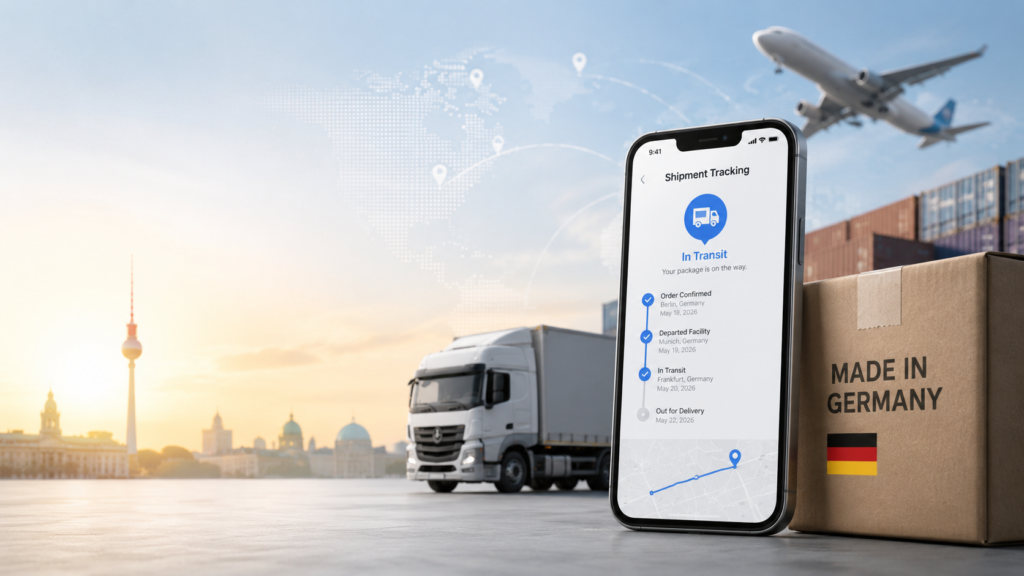
Waiting for an international package can be stressful, especially when it crosses multiple borders and changes carriers. If you recently ordered an item from a European retailer or have family overseas, you are likely wondering how to track shipment from Germany without losing your mind.
Germany boasts some of the most efficient logistics networks in the world, heavily dominated by giants like Deutsche Post and DHL. However, the moment a package leaves European soil, tracking updates can become confusing. The tracking number format might change, or the package may seem “stuck” at a facility for days.
In this comprehensive guide, we will show you exactly how to track shipment from Germany step-by-step. You will learn how to identify your carrier, understand tracking number formats, navigate the infamous “handover” to local couriers like USPS, and avoid common international shipping mistakes.
Table of Contents
- Major German Shipping Carriers
- Understanding German Tracking Number Formats
- The “Handover”: Tracking DHL/Deutsche Post in the US
- Step-by-Step: How to Track Shipment from Germany
- Common Mistakes and Expert Tips
- Frequently Asked Questions (FAQ)
- Conclusion
Major German Shipping Carriers
Before you can locate your package, you need to know who is handling it. The German logistics landscape is dominated by a few key players.
- Deutsche Post: The national postal service of Germany. They handle standard letters, registered mail, and small parcels.
- DHL Paket / DHL Express: DHL is actually a division of Deutsche Post. DHL Paket handles standard consumer packages, while DHL Express handles expedited, time-critical global shipments.
- DPD & Hermes: Popular carriers for domestic German deliveries and intra-European e-commerce shipments.
- GLS: Widely used for business-to-business (B2B) European shipping.
If you are receiving a package internationally, there is a [STATISTICS PLACEHOLDER]% chance it is being handled by DHL or Deutsche Post before it leaves Europe.
Understanding German Tracking Number Formats
One of the easiest ways to figure out how to track your package is by looking at the tracking number format. Different carriers use distinct character combinations.
Here is a quick comparison table to help you identify your carrier based on the tracking number:
| Carrier | Tracking Number Format | Example |
|---|---|---|
| Deutsche Post | 13 characters: 2 letters + 9 digits + “DE” | EE112233445DE |
| DHL Paket | 10 to 39 characters, often starting with GM, LX, RX, or digits | JVGL12345678 |
| DHL Express | 10 digits (often starting with 000, JJD01, etc.) | 0001234567 |
| DPD | 14 to 16 digits | 12345678901234 |
| GLS | Multiple formats (e.g., 11 digits, 14 digits) | 506129509800 |
If your tracking number ends in “DE”, it is a registered Deutsche Post international shipment.
The “Handover”: Tracking DHL/Deutsche Post in the US
The biggest source of panic for buyers in the US or Canada is the “handover.”
When a standard DHL Paket or Deutsche Post shipment leaves Germany, it is flown to an international sorting center. Once it clears US Customs, DHL hands the package over to a local courier—usually the United States Postal Service (USPS)—for final delivery.
How to track the handover:
- Put your standard DHL tracking number into the DHL tracking portal.
- Look for a status that says “Arrival in Destination Country” or “Arrived at Facility – Partner”.
- On the DHL tracking page, look for a secondary tracking number labeled “Delivery by Postal provider” or “Local Tracking Number.”
- Copy that secondary number and paste it directly into the USPS website.
If you ordered via DHL Express, there is no handover. DHL handles the delivery from door to door.
Need help managing multiple supplier shipments? Enter your email below to download our Free International Logistics Tracker Spreadsheet.
Step-by-Step: How to Track Shipment from Germany
Ready to find your package? Follow these actionable steps to track any shipment from Germany.
Step 1: Locate Your Tracking Number
Check your purchase confirmation email, shipping label, or SMS receipt. A Deutsche Post tracking number will typically have 13 characters ending in “DE”.
Step 2: Start with the Origin Carrier
Go to the official website of the German carrier (e.g., DHL.de or Deutsche Post). Enter your tracking number without any special characters. If the package is still in Germany, this site will provide the most accurate, real-time updates.
Step 3: Watch for Customs Clearance
Expect a pause in tracking updates when the package reaches the “International Sorting Center” or “Arrived at Customs”. Packages can sit in US Customs for anywhere from 24 hours to several weeks.
Step 4: Use a Universal Tracking Tool
If your package is bouncing between carriers, native tracking sites can become unreliable. Use a third-party universal tracking platform like Ship24 or Parcel Monitor. These tools auto-detect the carrier and pull data from both the German origin carrier and the local destination courier simultaneously.
Common Mistakes and Expert Tips
- Mistake: Panicking over an “In Transit” status. An “In Transit” scan simply means your package is moving between facilities or crossing the ocean. It is normal for international packages to go 5 to 7 days without a scan while on a cargo ship or plane.
- Mistake: Confusing DHL Paket with DHL Express. DHL Paket is standard international mail (slow, handed over to USPS). DHL Express is a premium courier service (fast, delivered by a yellow DHL truck).
- Pro Tip: Sign up for Live Tracking. If you are receiving a package locally within Germany, sign up for DHL Live Tracking to get a 90-minute delivery window and see exactly how many stops the driver has left.
- Pro Tip: Check your Spam Folder. Customs agencies will not contact you via tracking statuses alone. If duties or import taxes are owed, a DHL representative will attempt to contact the importer via email or mail.
Tired of complex logistics? Contact our team today to learn about our fully managed European freight and parcel forwarding services.
Conclusion
Learning how to track shipment from Germany doesn’t have to be a frustrating experience. By understanding the difference between Deutsche Post and DHL, recognizing your tracking number format, and knowing when to switch your tracking to USPS, you can stay informed every step of the way.
Remember that international shipping requires patience. Utilize universal tracking apps to keep all your shipments organized, and always double-check your local carrier once the package crosses the border.
3. FAQ Section
1. How long does shipping from Germany to the US take?
Standard shipments via Deutsche Post or DHL Paket usually take 10 to 21 business days. DHL Express shipments are much faster, typically arriving within 2 to 5 business days.
2. Why is my tracking number from Germany not updating?
Tracking usually pauses when a package is crossing the ocean, waiting for an available flight, or sitting in US Customs. It is completely normal to go 5 to 7 days without an update during international transit.
3. Does DHL hand over to USPS?
Yes, standard DHL Paket shipments from Germany are handed over to USPS for final delivery once they clear customs in the United States. You will be provided a secondary local tracking number to use on the USPS website.
4. What does “IPZ Frankfurt” mean on my tracking?
IPZ Frankfurt is the International Postal Centre in Germany. When your package shows this status, it is being processed for export and will soon be loaded onto an airplane or cargo ship leaving Germany.
5. How do I track a Deutsche Post package internationally?
You can start by tracking it on the Deutsche Post website. Once it leaves Germany, the best method is to use a universal tracking site like Ship24, which can track up to 10 Deutsche Post parcels simultaneously across global borders.