Navigating global logistics is more complex than ever. For businesses importing or exporting goods out of Europe’s largest economy, choosing between sea freight vs air freight Germany is the most critical supply chain decision you will make.
Global supply chain disruptions, port congestion, limited air cargo capacity, and stricter regulations have increased the impact of every single shipping decision. Importers, exporters, and procurement managers can no longer rely on pre-pandemic assumptions; they must focus on making the smartest choice based on risk, cost, and time constraints.
Whether you are shipping heavy machinery out of the Port of Hamburg or rushing high-value electronics from Frankfurt Airport, the right transport mode heavily impacts your bottom line. In this 2026 guide, we will break down the true costs, transit times, and operational risks of both sea freight Germany and air freight Germany to help you optimize your logistics strategy.
Table of Contents
- The Current State of German Logistics in 2026
- Sea Freight Germany: Overview, Pros, and Cons
- Air Freight Germany: Overview, Pros, and Cons
- Comparison Table: Sea Freight vs Air Freight
- Step-by-Step: How to Choose the Right Shipping Mode
- Expert Tips and Common Mistakes
- Conclusion
The Current State of German Logistics in 2026
Germany remains the undisputed transhipment hub for the flow of goods in Europe and the world. The logistics sector is a massive economic engine here, employing over three million people and ranking as the third-largest economic sector in the country.
However, the freight landscape in 2026 is evolving. Ocean routes are experiencing vessel overcapacity, which has pushed spot rates down significantly. Meanwhile, air freight rates remain relatively high due to capacity constraints and geopolitical disruptions affecting jet fuel prices. Shippers must evaluate these shifting dynamics to make cost-effective decisions.
Sea Freight Germany: Overview, Pros, and Cons
Sea freight Germany is the backbone of the country’s massive export economy. The Port of Hamburg, often called Germany’s gateway to the world, processes around eight million shipping containers each year.
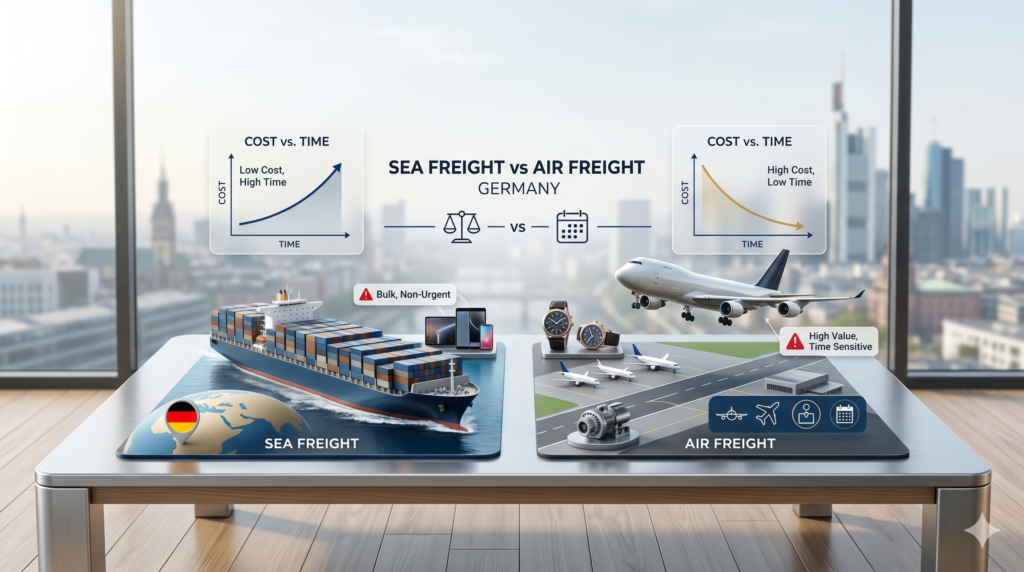
Sea freight prioritizes cost efficiency, scale, and long-term planning. It is ideal for large volumes, heavy cargo, and flexible timelines where reducing transportation costs is the ultimate priority.
Pros:
- Cost-Effective for Large Volumes: Ocean freight is significantly cheaper than air freight for bulk goods. In 2026, massive vessel overcapacity has even created a buyer’s market, pushing spot rates down.
- Better Cash Flow: The relatively low transportation cost allows for smoother cash flow planning.
- Environmentally Friendlier: Sea freight produces a significantly lower carbon footprint per ton of cargo compared to air transport.
Cons:
- Longer Transit Times: Shipping by sea takes several weeks, making it unsuitable for urgent deliveries.
- Moderate to High Delay Risk: Schedules are influenced by port congestion, weather events, and maritime chokepoints.
- Complex Regulatory Handling: Customs clearance and documentation for ocean freight can be complex and slower than air freight.
Air Freight Germany: Overview, Pros, and Cons
When speed is non-negotiable, air freight Germany is the clear winner. Frankfurt Airport handled roughly 2.1 million tonnes of air freight in 2024, maintaining its position as the leading European cargo airport.
Air freight is preferred for urgent shipments, high-value goods, time-sensitive cargo, or when delays could cause financial or operational damage.
Pros:
- Unmatched Speed: Transit times are extremely fast, usually taking only a few days from origin to destination.
- High Schedule Reliability: While subject to aircraft capacity, air freight generally operates on strict, reliable timetables.
- Lower Delay Risk: The risk of extended delays is low to moderate compared to ocean routes.
- Ideal for Sensitive Cargo: Excellent for pharmaceuticals, electronics, and goods with a short shelf life.
Cons:
- Significantly Higher Transportation Cost: Air freight rates are steep, requiring a high upfront cost.
- Vulnerable to Fuel Prices: Increased jet fuel prices directly cause rate spikes for shippers.
- Volume Limits: Strict weight and size restrictions make it uneconomical for heavy, bulky goods.
[Email Opt-in CTA Placeholder: “Struggling to track your container shipments? Enter your email below to get our free 2026 Ocean Freight Transit Time Calculator sent straight to your inbox!”]
Comparison Table: Sea Freight vs Air Freight
To help you make the right choice in 2026, here is a clear breakdown of the fundamental differences. Decision-makers should evaluate cost, risk, and time simultaneously.
| Feature | Air Freight Germany | Sea Freight Germany |
|---|---|---|
| Transit Time | Very fast – a few days | Long – several weeks |
| Transportation Cost | Significantly higher | Relatively low |
| Schedule Reliability | High, subject to aircraft capacity | Influenced by port congestion and weather |
| Delay Risk | Low to moderate | Moderate to high |
| Suitability for Sensitive Cargo | High | Limited |
| Economic Efficiency | Small or high-value shipments | Large or heavy shipments |
Step-by-Step: How to Choose the Right Freight Mode
Follow this practical process to determine whether your cargo should fly out of Frankfurt or sail out of Hamburg.
Step 1: Calculate the Chargeable Weight
Validate your chargeable weight for air decisions using a freight calculator to establish a baseline. If your shipment is small and dense, air freight might be closer in price to LCL (Less than Container Load) sea freight than you expect.
Step 2: Analyze Your Timeline and Inventory
Can your supply chain absorb a 30-day transit time? If you have sufficient buffer inventory and early planning, sea freight provides substantial cost savings. If stockouts are imminent, switch to air freight.
Step 3: Assess the Risk Profile of the Goods
Evaluate the cargo. For example, if you are shipping medical equipment with strict regulatory needs and a short shelf life, sea freight increases the risk of product loss; air freight becomes a necessity for compliance.
Step 4: Factor in Hidden Costs
Delays can create indirect costs such as storage fees, penalties, and lost sales. Ensure your procurement KPIs track the total landed cost and reliability, not just the base linehaul rate.
Step 5: Lock in Quotes
Request quotes for both modes from your freight forwarder. Remember to factor in port handling, customs fees, and inland trucking across Germany’s 13,210 kilometres of motorways.
Expert Tips and Common Logistics Mistakes
- Mistake: Ignoring the “Hidden” Costs of Sea Freight. Many shippers assume sea freight is automatically cheaper. However, a low upfront price that ignores clearance times, indirect costs, and potential delay penalties can ultimately become the most expensive option.
- Mistake: Failing to Plan for Volatility. International freight in 2026 rewards shippers who plan for volatility and optionality. Do not build customer promises on best-case transit scenarios; build them on a managed variance range.
- Pro Tip: Your lane strategy should include approved alternates, such as different origin ports, destination ports, and predefined triggers for switching between ocean and air modes.
Conclusion
The debate between sea freight vs air freight germany does not have a one-size-fits-all answer. The correct choice depends entirely on your cargo type, financial exposure, timelines, and risk tolerance.
If your priority is massive volume and cost control, leverage the robust infrastructure of German seaports. If speed and schedule integrity are paramount, the premium paid for air transport will protect your business from costly stockouts. By understanding the cost-risk-time equation, modern businesses can build highly resilient and profitable supply chains.
[Service CTA Placeholder: “Need help optimizing your European supply chain? Contact our team of German logistics experts today for a free freight consultation and route audit.”]
3. FAQ Section
1. What is the main difference between air freight and sea freight?
The main difference is speed versus cost. Air freight is much faster but significantly more expensive, while sea freight is slower and highly cost-effective.
2. When should air freight from Germany be preferred?
Air freight is preferred for urgent shipments, time-sensitive cargo, high-value goods, or when shipping delays could cause operational or financial damage.
3. When is sea freight from Germany the right choice?
Sea freight is suitable for large volumes, heavy cargo, flexible timelines, and situations where lowering transportation costs is the main priority.
4. Is air freight always more reliable than sea freight?
Not always. While generally faster and more reliable, air freight still depends on aircraft capacity, strict security checks, and detailed regulatory procedures.